Rexrode/Lautenschläger (Lautenschlager) Ancestry
Sources:
- Archive of Rexroad Family History (copyrighted 1996) by Michael Lee Rexroad (who himself is a source as well)
- Schneider Family Site - Family Tree at MyHeritage.com - Dalles Schneider
- Ancestors of Lillie Lieu Smith by Warren Berlin Crummett
- Heidi Banse, Vorfahren der Familie Banse
- A History of the Descendants of Zachariah Rexrode of Pendleton County, Va., (W. Va.) by Walter L. Eye
- Ancestor - Elisabetha Lautenschläger (1650-1721) by Nancy Simmons Roberson
The Rexroth name, as well as other spelling variations, is a habitational name for someone from a former village near Wanfried in Hesse on the Werra River near Thuringia. This village is mentioned in the literature for the first time in 1337 as Reystras and in 1490 as Rexraide. Spelling variations of this family name include: Rexrodt, Rexrode, Rexroad, Rexroth, Reckrodt, Rexerode, Reckrode, Reckrodt, Reckroth and many more.
Legend says that this family served as weapons and armor maker for Otho or Otto II, crowned in 961 the Emperor of Germany. He was nicknamed Otto the Red. The family supposedly showed their loyalty to Otto II by taking the name, "von Rexroth". "Rex" meaning king, "Roth" being an old German word for Red. Thus the name "von Rexroth" means "from the red king". There seems to be no factual basis for this legend.
Source: Michael Lee Rexroad, Archive of Rexroad Family History (copyrighted 1996).
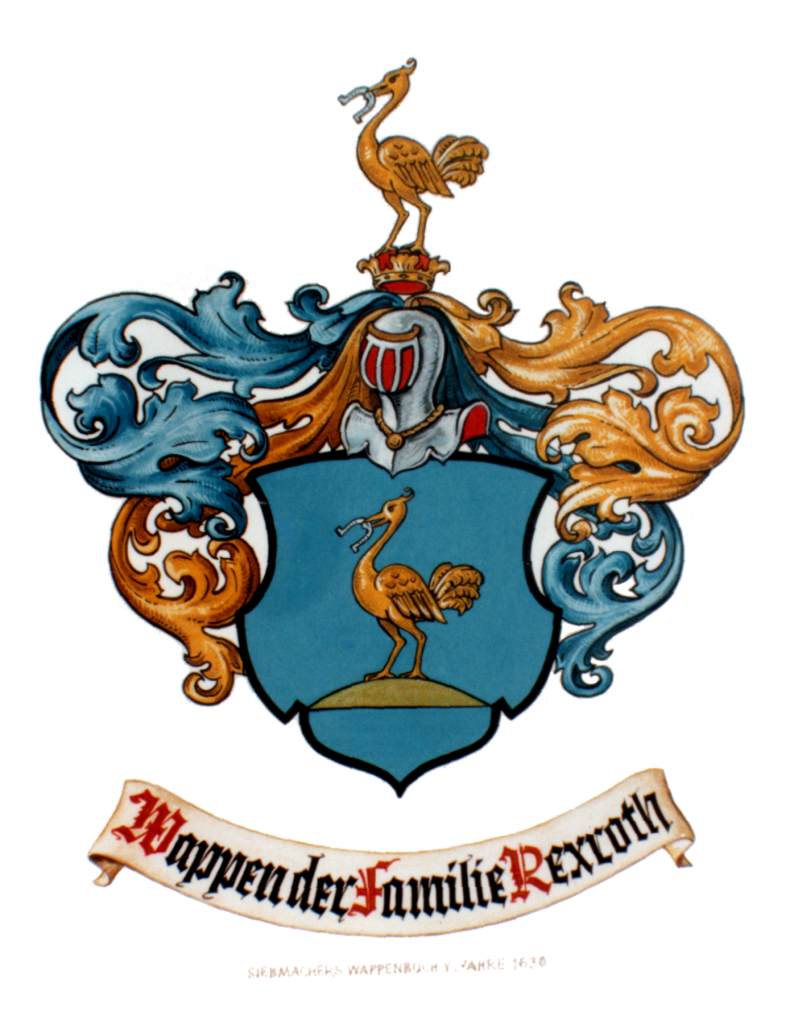
← Granted to Rexrode or von-Rexrode from Wanfried in Hesse of southwestern Germany between Thuringia and the Rhine River (Source: Eye).
Another version of the von-Recksrodt/Reckerodt/Rexrode/Rexroad shield is below: 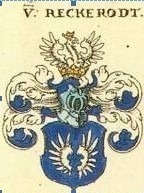

| Hans Rexsrodt b. ca. 1480 He married. d. ca. 1540 Wanfried, Hesse, Germany |
Hans Dorfheilige (b. Wanfried, Hesse, Germany) m. Dorothea (maiden name unknown) She died in Wanfried, Hesse, Germany. |
|||||||
| | ↓ |
| ↓ |
|||||||
| Joachim Recksrodt/Rexsrodt b. ca. 1510 d. ca. 1570 Wanfried, Hesse, Germany |
m. | N. N. Dorfheilige | ||||||
| | ↓ |
||||||||
| Dietrich Recksrodt/Rexsrodt b. ca. 1554 Wanfried, Hesse, Germany |
m. | ? | ||||||
| | ↓ |
||||||||
| Hans Recksrodt b. in Wanfried, Hesse, Germany |
m. | ? | ||||||
| Lenhard Lautenschläger b. 1560, Hesse, Germany Lenhard married. |
| | | ↓ |
|||||||
| | | ↓ |
Johannes Recksrodt | Maria Magdalena (maiden name unknown) |
||||||
| Wilhelm Lautenschläger b. ca. 1578 Günterfürst, Hesse-Darmstadt, Germany d. 1625 in Erbach, Odenwald, Hessen, Germany |
Wilhelm first married Catharina Ihrig (1570-1613). However, he later married 18 May 1614 in Güttersbach, Odenwaldkreis, Hessen, Deutschland (Germany)to Apollonia Wagner (b. 1580) who was mother of Hans. | Apollonia Wagner b. 1580 d. in Güttersbach, Odenwaldkreis, Hessen, Deutschland (Germany). Apollonia was Wilhelm's second wife. |
b. 1595 Wanfried (near Kassel), Hesse, Germany d. pre 21 June 1621 Smirschitz, near Koniggratz, Bohemia |
m. | b. 1606 in Wanfried, Hesse, Germany d. 28 Oct 1692, Erbach, Hesse, Germany, age 86 |
|||
| | | ↓ |
||||||||
| | | ↓ |
| | ↓ |
|||||||
| Hans Lautenschläger | Wenzeslaus (Wenzel) Recksrodt | According to Walter Eye, Wenzeslaus Recksrodt was born in Schmiersiz in Bohemia and came to Erbach in Odenwald during the Thirty Years War with a count in the Imperial Austrian Service. He married there and was a blacksmith. | Veronika (maiden name unknown) |
Wenzeslaus Recksrodt was born shortly after his father's death and remained in Bohemia for many years. He married and had at least one child there, but eventually made his way back to Germany. But settled in a slightly different part of the country than where his ancestors had lived.
|
||||
| b. 11 June 1615 Güttersbach, Hesse-Darmstadt, Germany He married Anna before 1643. d. 27 March 1675 Güttersbach, Hesse-Darmstadt, Germany, age 59 |
b. 21 June 1621 in Smirschitz, Bohemia d. 21 June 1705 in Erbach, Odenwald/Hesse, Germany |
m. ca. 1644 Smirschitz, Bohemia |
b. 1618 Smirschitz, Bohemia d. 28 October 1662 or 1692 in Erbach, Odenwald/Hesse, Germany |
|||||
| | | ↓ |
||||||||
| | | ↓ |
| | ↓ |
|||||||
| Ancestor - Elisabetha Lautenschläger (1650-1721) by Nancy Simmons Roberson | Elisabeth Lautenschläger | Hans Barthel Recksrodt/Rexroth | ||||||
| b. 16 June 1650 Güttersbach, Hesse-Darmstadt, Germany d. 17 September 1721 in Erbach, Odenwald/Hesse, Germany |
m. 20 Jun 1671 in Erbach, Hesse, Germany, Hans' second Their marriage and family (source: Hessisches Geschlechterbuch, Volume 94 -- provided by Nancy Simmons Roberson) |
b. 1645 in Erbach, Odenwald, Germany or Smirschitz, Bohemia d. 26 April 1694 in Erbach, Odenwald/Hesse, Germany |
||||||
| | | ↓ |
||||||||
| He was a blacksmith in Erbach. | Johan Balthasar Rexrode (Recksrodt) | ↑ Johanna Lowisa Christina Küchler (Kuchler) |
||||||
| b. 11 June 1673 in Germany d. 16 August 1734 in Erbach, Odenwald, Germany |
m. 19 June 1710 Erbach, Hesse, Germany |
b. 7 January 1690/1691 Erbach, Hesse, Germany d. 11 Dec. 1726 Erbach, Hesse, Germany |
Johanna bore Johann Balthaser seven children. When the youngest was one year old, Johanna died. | |||||
| | | ↓ descendants |
||||||||
Johannes Recksrodt + Maria Magdalena (maiden name unknown)
+------------------+------------------------+
|b. about 1600 in  |b. about 1600 in GERMANY|
|Wanfried, near    |                        |
|Kassel, GERMANY.  |                        |
|d. in Smirschitz, |                        |
|near Koniggratz,  |                        |
|Bohemia, GERMANY. |                        |
+------------------+------------------------+
                   |
                   |
              Wenzelslaus   Veronika
              Recksrodt   + (maiden name unknown)
+-------------------------+----------------------+
|b. 1621 in Smirschitz,   |b. 1618               |
|Bohemia, GERMANY.        |d. 28 October 1692 in |
|d. 21 June 1705 in       |Erbach, Odenwald,     |
|Erbach, Odenwald, GERMANY|GERMANY               |
+-------------------------+----------------------+
                          |
                          |
                        Hans        Elisabeth
                        Barthel   + Lautenschläger
                        Recksrodt |
              +-------------------+----------------+
              |b. 1645 in Erbach, |b. about 1650 in|
              |Odenwald, GERMANY  |   GERMANY      |
              |d. 26 April 1694 in|d. 17 Sept. 1721|
              |Erbach, Odenwald,  |in Erbach,      |
              |GERMANY            |Odenwald,GERMANY|
              +-------------------+----------------+
                                  |
                                  |
                                  |
                                Johan          Johanna
                                Baltasar    +  Lowisa
                                Rexrode     |  Christina
                                (Recksrodt) |  Kepler
                +---------------------------+
                |b. 11 June 1673 in GERMANY |
                |d. 16 Aug. 1734 in Erbach, |
                | Odenwald, GERMANY         |
                +---------------------------+